


Open presentation of the results of the EVAR-Twin project
Research of intelligent digital twins for endovascular prosthetic devices
On June 24th, we will present the results of EVAR-Twin, a project that applies artificial intelligence, digital twins, and advanced simulation to clinical support in vascular surgery.
29/05/2026
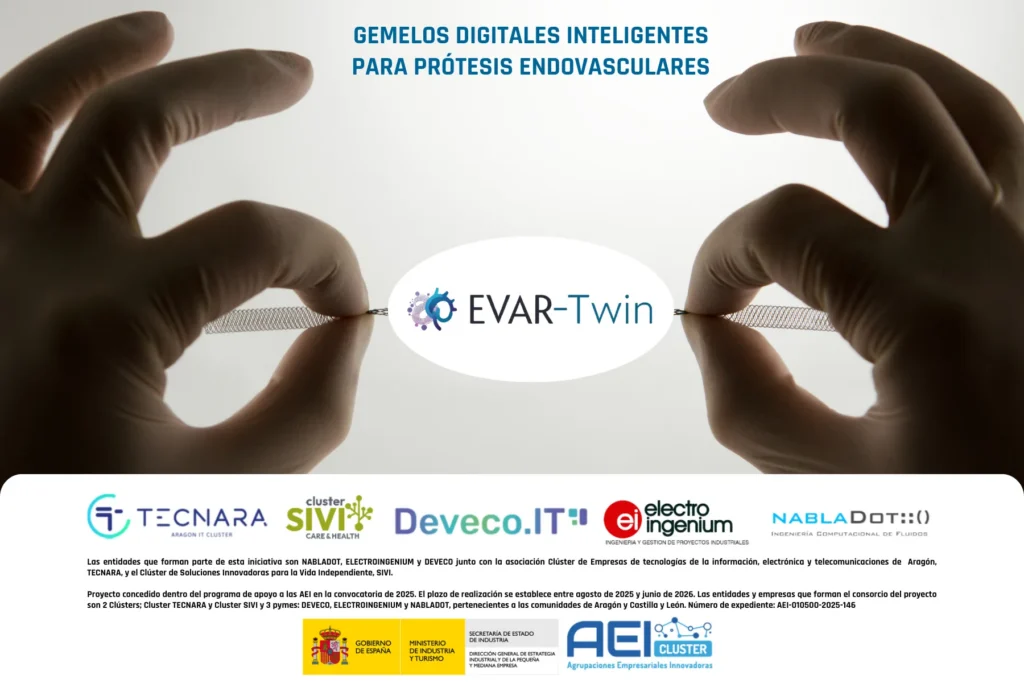
Next Wednesday, June 24, at 11:00 a.m., the final results day of the EVAR-Twin project will take place online.
The project is part of the 2025 support programme for Innovative Business Clusters (AEI) and runs from August 2025 to June 2026. The consortium brings together 2 clusters (TECNARA and SIVI) and 3 SMEs (ELECTROINGENIUM, NABLADOT and DEVECO) from Castilla y León and Aragon.
The project applies artificial intelligence and digital twins to clinical support in vascular surgery with a clear goal: improve the prediction of thrombogenic risk after endovascular repair procedures for abdominal aortic aneurysms (EVAR).
Participation is open and free of charge. More information and registration: https://forms.gle/gHDBQ4XnbUs1MDnw7
What is EVAR-Twin?
EVAR-Twin is a semi-automated clinical support tool for vascular surgeons that assesses how the blood flow behavior influences the formation of thrombi after an EVAR procedure.
The platform combines advanced computational fluid dynamics (CFD) simulations, artificial intelligence, and automated medical image processing to generate personalized in silico models of the patient.
Based on tomographies, MRIs and simulation data, the system generates digital representations capable of predicting postoperative thrombogenic risk and simulating different therapeutic scenarios.
How it works
The platform automates the entire workflow: from the construction of three-dimensional models to the resolution of hemodynamic equations under realistic physiological conditions and the automated analysis of results.
The models simulate the interaction between the blood, the endoprosthesis and the vascular walls to identify areas with a higher risk of thrombosis.
Artificial intelligence is used both in image processing and predictive analysis, improving early detection and stratification of clinical risk. Moreover, the developed architecture is agnostic to geometry and the type of fluid being analyzed, opening the door to future applications beyond the vascular field.
Clinical value
EVAR-Twin helps healthcare professionals make more informed decisions, reduce postoperative complications, and optimize clinical resources.
Its automation facilitates adoption in hospitals without the need for specialists in advanced simulation, and in the medium term, the technology could be commercialized as a licensed product or integrated into existing digital medical platforms.
The project also contributes to improving the quality of life and survival of patients with vascular diseases, fostering more efficient healthcare management in the face of population aging and strengthening collaboration between the technological and healthcare sectors.
Institutional information
Consortium

Co-funded project
EVAR-Twin helps healthcare professionals make more informed decisions, reduce postoperative complications, and optimize clinical resources.
Its automation facilitates adoption in hospitals without the need for specialists in advanced simulation, and in the medium term, the technology could be commercialized as a licensed product or integrated into existing digital medical platforms.
The project also contributes to improving the quality of life and survival of patients with vascular diseases, fostering more efficient healthcare management in the face of population aging and strengthening collaboration between the technological and healthcare sectors.
