


Automating customer service from WhatsApp
AST Roll Cages has incorporated an artificial intelligence assistant connected to its ERP to answer queries, recommend products, and provide information about orders in real time, directly from WhatsApp.

- Automotive · Motorsport
- Multilingual · Connected ERP · 24/7 support
The challenge
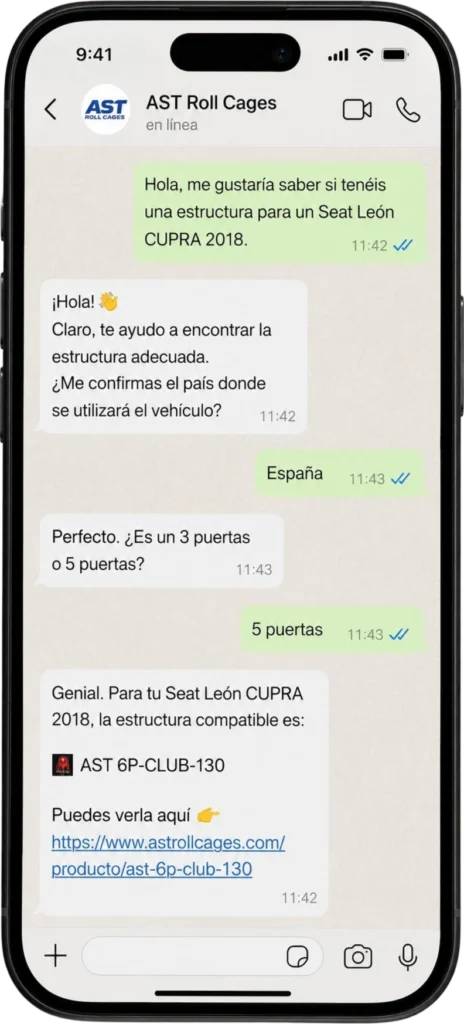
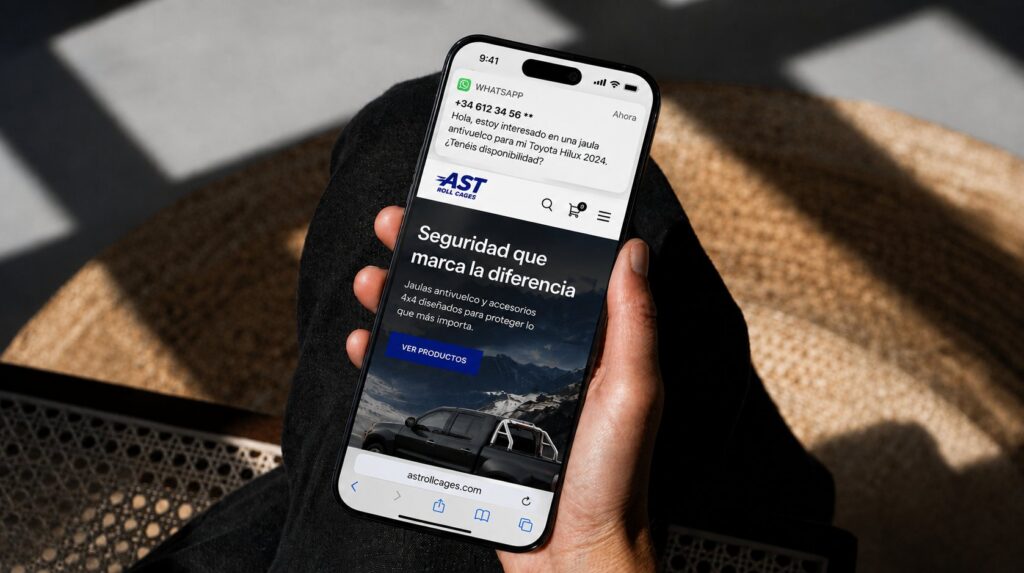
Customers of AST Roll Cages use WhatsApp to resolve all their questions: check the status of an order, find the appropriate roll cage, or request information about a product.
Each conversation required a team member to interrupt their work to access the ERP system, locate the information, and respond manually. A repetitive process that consumed business time.
Key challenges
- Repeated consultations every day.
- Information distributed across different systems.
- Commercial time dedicated to low-value tasks.
- Answers depend on the team's schedule.
The solution
We developed an artificial intelligence assistant integrated directly into WhatsApp Business and connected to the AST Roll Cages ERP.
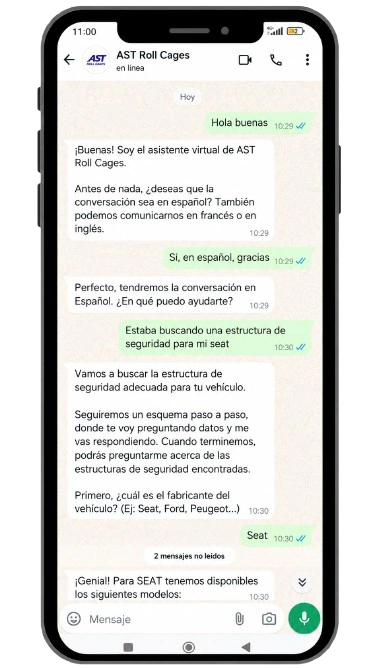
The assistant understands each query, retrieves the necessary information in real time, and responds automatically in the customer's language.
When it detects a conversation that requires human intervention, it routes the conversation to the appropriate team.
WhatsApp Business
AI Assistant from Deveco
ERP
Customer response
How it works, step by step
Tech stack
- WhatsApp Business API
- Enfoca (Conversational AI)
- Integration with ERP
The customer writes via WhatsApp
You can ask about an order, request a recommendation, or resolve any questions about a product.
The AI interprets the query
It takes into account the customer's intent and asks the customer step-by-step for the details of their vehicle (make, model), until it finds the appropriate option.
Consult the ERP
Access real-time information to obtain updated data and check the status of orders.
It responds automatically
Provide a clear, immediate response adapted to the client’s language.
Escalates when needed
If the conversation requires human attention, it hands it over automatically to the relevant department.
Do you want results like this in your company?
Tell us about your case. We’ll give you a first assessment without obligation in less than 24 hours.
Other cases that may interest you


AI-based telephone assistant
Zaragoza Central Bus Station
The team received many repetitive calls asking about schedules and routes. Now HeyLaia, the AI assistant automatically answers those questions by phone, 24 hours a day, and only passes the call to a person when necessary.

AI and digital twins
EVAR-Twin
Evaluating the risk of thrombosis after an aortic surgery requires combining imaging tests, anatomical models, and simulations that are expensive and difficult to integrate into daily practice. Now a digital twin of the patient themselves automates the entire process, from image segmentation to risk prediction.